When Is a Cross a Cross? →
Interesting perspective on the Supreme Court's ruling Salazar v. Buono which, in the words of the author, continues "saving religion by emptying it of its content." The case centers on a cross in the Mojave National Preserve erected by the V.F.W. in memoriam.
In other news, it was stolen today: http://www.csmonitor.com/USA/2010/0511/Mojave-cross-theft-shows-planning-veterans-groups-vow-to-rebuild
Obama's Hampton Address →
With iPods and iPads; Xboxes and PlayStations; information becomes a distraction, a diversion, a form of entertainment, rather than a tool of empowerment. All of this is not only putting new pressures on you; it is putting new pressures on our country and on our democracy.I feel that this quote is being taken out of context frequently. The rest of his speech is about the power of education and democracy, and is actually very good.
Crime Drop Might Boost O'Malley →
Maryland Gov. Martin O'Malley is scheduled to announce Monday that the state recorded fewer violent crimes last year than at any point since 1979 and that the overall number of crimes dipped to an all-time low since Maryland police began uniformly reporting them more than 35 years ago.Still,
Homicides in Baltimore increased by four, to 238, last year. A year earlier, the city had the fifth most homicides among U.S. cities.

"Is it funny or not?" - Jesse
Understand the Web →
Meanwhile, Sachin Agarwal is writing that The Web Sucks, again talking about the web as an application platform:
Web applications don't have threading, GPU acceleration, drag and drop, copy and paste of rich media, true offline access, or persistence. Are you kidding me?
There, in that quote, is where I want to pull all of this together. Sachin's complaint has absolutely nothing to do with the web. Think about that word; 'web'. Think about why it was so named. It's nothing to do with rich applications. Everything about web architecture; HTTP, HTML, CSS, is designed to serve and render content, but most importantly the web is formed where all of that content is linked together. That is what makes it amazing, and that is what defines it. This purpose and killer application of the web is not even comparable to the application frameworks of any particular operating system.
That's the kicker. We talk about 'web applications', the 'open web stack'. People are citing HP's purchase of Palm and investment in WebOS as a victory for the web. We talk about applications built using HTML, CSS and JavaScript in the same breath as content published using HTML semantics.
Want to know if your 'HTML application' is part of the web? Link me into it. Not just link me to it; link me into it. Not just to the black-box frontpage. Link me to a piece of content. Show me that it can be crawled, show me that we can draw strands of silk between the resources presented in your app. That is the web: The beautiful interconnection of navigable content. If your website locks content away in a container, outside the reach of hyperlinks, you're not building any kind of 'web' app. You're doing something else.
Palm WebOS applications are awesome, but they are not part of the web. An app might interact with data on the web, and they are built with similar HTML, CSS and JavaScript technologies. That's great, but they are not a connected, interlinked part of the web.
We're talking about two very different things: The web of information and content, and a desire for a free, cross-platform Cocoa or .NET quality application framework that runs in the browsers people already use. The latter cause is louder, and risks stomping over the more valuable, more important, more culturally indispensable part of the web.
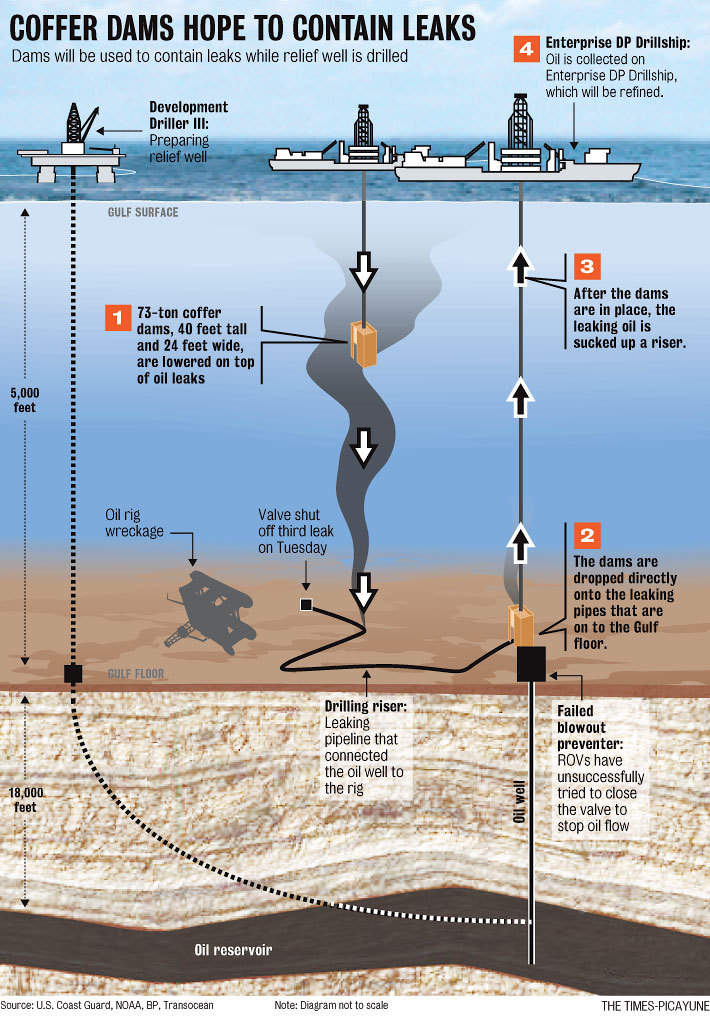
And the follow-up graphic on how they're trying to fix it.

Finally someone publishes something that sufficiently explains exactly what happened on the Deepwater Horizon on April 20. Thanks to The Times-Picayune.
How Google Got Its New Look →
Interesting look at some of the design processes and decisions behind Google's new search engine rollout.
The first story is that the NYSE system somehow broke down, and that's scary. There are going to be a lot of questions about program trading, because that's touched off the decline. If computers are running the world instead of people, people are going to lose confidence in the financial institutions.
— Carl Birkelbach, Chairman and CEO of Birkelbach Investment Securities in Chicago