Android: Fragmentation or Innovation? →
Google won't control what partners do with Android, but by constantly raising the bar it controls the platform's pace as well as the vision. As with most things, in the end it will be Google's partners and their customers that will determine whether that pace is acceptable, and that will either become a competitive advantage or provide an opportunity for other platforms to succeed.
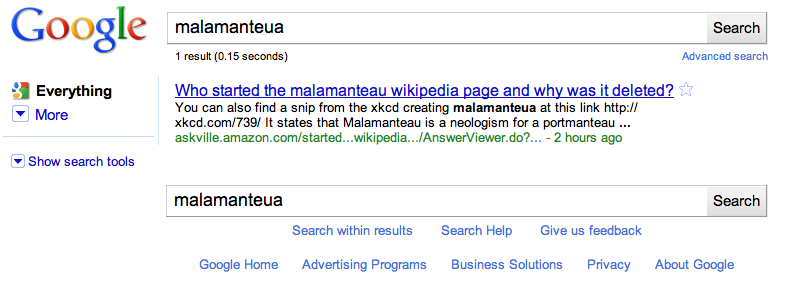
For just a few minutes last week, this was the only Google Search Result for "malamanteau". There are now 80,300. Not googlewhacked according to the official rules, but satisfying nonetheless.
Final Thoughts on LOST
While the emphasis in this series finale was on the heart of the island, the show lost its own heart. What was supposed to be a revealing, emotional, climactic episode endangered the whole series with an cop-out ending that clarified nothing, was neither epic nor mysterious nor surprising, and most of all, inspired no emotion for any of the characters. It basically pulled a Battlestar.
Uncivil for church leader to remove name from civility statement? →
A leader of one of America's largest Christian denominations wants his name removed from a statement calling for a more civil national discourse. Why? Too many of the wrong sort of Christians have signed the statement.Source: David Waters, The Washington Post
"The problem is the tent that has grown so large on the signatures of this that are including people who are supportive of gay marriage and abortion rights," explained a spokesman for George O. Wood, general superintendent of the Assemblies of God, the nation's second largest Pentecostal groups.
Is it an act of incivility to have your name removed from a "Covenant for Civility"?
Rand Paul and the Perils of Textbook Libertarianism →
Mr. Paul's quandary reflects the position of the Tea Partiers, whose antipathy to government, rooted in populist impatience with the major parties, implies a repudiation of politics and its capacity to effect meaningful change.
Change can't be made outside of the channels of political power in any movement.

A look at the battle fronts between Microsoft, Google, and Apple. From Gizmodo.
John Gruber has some notes on this war after Google I/O.
Saving Star Wars: The Special Edition Restoration Process and its Changing Physicality →
On the 30th anniversary of "The Empire Strikes Back", a great chapter from the book The Secret History of Star Wars on the history of the two special editions and the process of film modification in the digital era.
Jobs Drops Hint on VP8 →
Sounds like he doesn't like it...
Satisfaction With U.S. Historically Low for Midterm Year →
So far in 2010, an average of 23% of Americans have been satisfied with the way things are going in the United States. That is well below the 40% historical average Gallup has measured since 1979, when it began asking this question. The 2010 average is also the lowest Gallup has measured in a midterm election year, dating to 1982.Interesting...
In-Depth Technical Analysis of VP8 →
Great analysis of the pros and cons behind the spec and implementation of Google's new open-source video codec. Summary:
VP8, as a spec, should be a bit better than H.264 Baseline Profile and VC-1. It's not even close to competitive with H.264 Main or High Profile. If Google is willing to revise the spec, this can probably be improved.
VP8, as an encoder, is somewhere between Xvid and Microsoft's VC-1 in terms of visual quality. This can definitely be improved a lot, but not via conventional means.
VP8, as a decoder, decodes even slower than ffmpeg's H.264. This probably can't be improved that much.
With regard to patents, VP8 copies way too much from H.264 for anyone sane to be comfortable with it, no matter whose word is behind the claim of being patent-free.
VP8 is definitely better compression-wise than Theora and Dirac, so if its claim to being patent-free does stand up, it's an upgrade with regard to patent-free video formats.
VP8 is not ready for prime-time; the spec is a pile of copy-pasted C code and the encoder's interface is lacking in features and buggy. They aren't even ready to finalize the bitstream format, let alone switch the world over to VP8.
Google made the right decision to pick Matroska and Vorbis for its HTML5 video proposal.